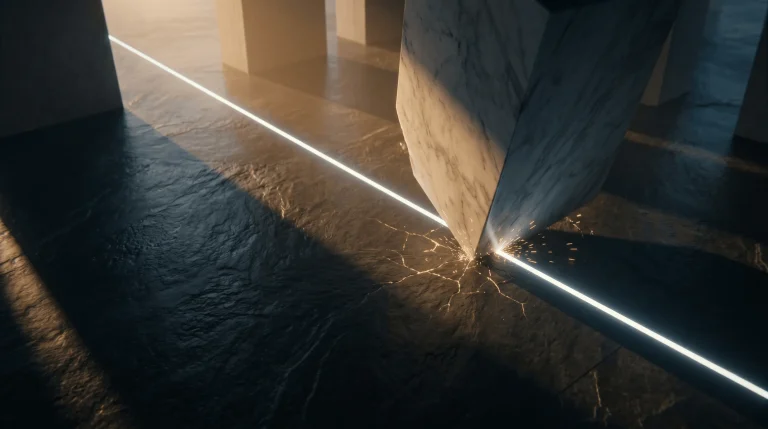


The Geometry of Ongoing Momentum
Few human impulses are quite as seductive (or quite as destructive) as the sudden, overwhelming desire to burn down the blueprint and start entirely anew. As late September settles in and the final quarter of the year looms on the immediate horizon, a familiar psychological restlessness begins to permeate the air. You look back across the preceding nine months, notice the hairline fractures in your early routines, calculate the distance between your original January aspirations and your gritty autumn reality, and immediately feel the urge to declare bankruptcy on the whole enterprise. We tell ourselves that if our execution cannot be immaculate, it is better to wipe the board clean, retreat into a holding pattern, and wait for the magical, pristine threshold of a brand-new calendar year.
This reactionary drive toward total demolition is an optical illusion born of exhaustion. We are culturally conditioned to romanticise the tabula rasa (that mythical, untouched expanse of white marble where no mistakes have yet been etched). Yet, in real-world construction, nobody demolishes a multi-storey building simply because a single support column requires underpinning or an interior partition settled unevenly. Real architecture does not demand perpetual demolition; it demands structural shoring. If you wish to build a life capable of weathering continuous flux, you must abandon the childish fantasy of the clean slate and master the far more demanding, deeply rewarding art of working with existing momentum.
The Seductive Delusion of the Blank Canvas
The clean slate promises total absolution without the messy inconvenience of repair. When our habits falter, or when the friction of daily logistics derails our carefully calibrated systems, the prospect of starting fresh feels invigorating. It delivers an instant, unearned wash of psychological relief (the comforting fiction that tomorrow’s hypothetical self will somehow be immune to the cognitive inertia and fatigue that undermined us today).
Total demolition is merely procrastination masquerading as a high standard of excellence.
What we fail to realise is that declaring a clean slate does not eliminate our baggage; it simply resets our progress back to zero while leaving our underlying faults completely unaddressed. When you scrap an imperfect routine to “wait for the right time” (whether that means next Monday, the first of next month, or the looming precipice of January 1st), you are not exercising discipline. Rather, you are engaging in a sophisticated form of evasion. You discard the valuable, load-bearing foundation already poured simply because the surface finish shows signs of wear. Underneath this perfectionist posturing lies a profound fear of confronting the messy, unglamorous reality of ongoing maintenance.
In classical mechanics, an object in motion possesses kinetic energy that cannot simply be wished out of existence; it can only be transferred or redirected. The exact same law governs your behavioural psychology. Even when your trajectory feels scattered or sluggish, you possess hard-won kinetic momentum (accumulated lessons, refined instincts, and the mechanical memory of past efforts). To smash the brakes and demand a clean slate forces you to absorb the catastrophic kinetic shock of a dead stop, guaranteeing that restarting later will require monumental, exhausting force.
The Mechanics of Structural Shoring
When civil engineers encounter an aging bridge or an historic cathedral showing signs of structural settlement, their first instinct is never to plant dynamite at the base. Instead, they engage in the rigorous craft of structural shoring: introducing temporary load-bearing props, driving hydraulic jacks beneath the foundations, and reinforcing the existing steelwork while the entire edifice remains standing.
They understand an immutable physical reality: the structure cannot simply pause its duty to accommodate repairs. It must continue to bear its own weight, resist the surrounding elements, and carry active traffic while the retrofitting takes place.
The true test of mastery is not whether you can build on pristine ground; it is whether you can reinforce the frame while the structure is still under load.
Your life operates under this exact constraint. You do not possess the luxury of placing your professional obligations, mental equilibrium, or daily existence into suspended animation while you wait for ideal conditions. Demanding a clean slate before you agree to show up is the intellectual equivalent of refusing to repair a leaking roof until the sun shines on an empty field. You must learn to retrofit the engine mid-flight.
Structural shoring in daily practice means identifying the exact point of failure without condemning the entire building. If your morning routine collapsed over the past fortnight, you do not scrap your entire organisational philosophy; you simply shore up that specific thirty-minute window. If your written ledger has accumulated three days of neglected silence, you do not throw the notebook into the bin and wait for a new month; you simply draw a pencil line across the page, record your coordinates from where you stand, and continue the logbook without dramatic apology.
Working with the Crooked Timber
Much of our modern frustration stems from the persistent, unhelpful expectation that our growth should trace a clean, linear vector across a sterile grid. When reality deviates from this immaculate geometry (and life in continuous flux guarantees that it always will), we interpret the deviation as an indictment of our character.
Yet, any experienced carpenter will tell you that true craftsmanship lies in working with the natural grain, knots, and slight imperfections of the timber, not in throwing the wood aside because it refused to be perfectly straight. The missteps, interrupted sequences, and chaotic detours of your year are not fatal defects; they are the actual material from which your resilience must be carved.
When you learn to work with existing momentum, an interrupted habit ceases to be a crisis. You stop interpreting a slip as a catastrophic breach of contract that requires you to retreat to the starting line. Instead, you view it through a calm, diagnostic lens:
- A skipped workout is merely an unrecorded metric, not a licence to abandon your physical baseline for the remainder of the season.
- An over-committed week is not proof that your systems are broken; it is an immediate signal that your structural clearances have been compromised and require re-establishing.
- A fractured routine is not an invitation to demolish the blueprint, but an urgent call to shore up the remaining load-bearing beams.
By refusing to give in to the all-or-nothing panic of the clean slate, you preserve your underlying momentum. You keep the internal machinery warm, ensuring that when the friction clears, you are already moving forward rather than staring down the daunting chore of initiating momentum from a cold, dead stop.
The Fourth-Quarter Calibration
As we cross the threshold into the final quarter of the year, resist the ambient pressure to write off 2026 as a foregone conclusion. Do not succumb to the seductive whisper that says you might as well coast through autumn and wait for the winter holidays to grant you a cosmic reprieve.
There are no cosmic resets. There are no clean slates. The version of you that wakes up on January 1st will inherit the exact same psychological scaffolding, cognitive blind spots, and habit loops that you cultivate across the quiet afternoons of October and November. If you spend the next three months abandoning your framework in anticipation of a New Year’s miracle, you will simply arrive at the starting line exhausted, out of practice, and forced to rebuild your foundation from the rubble.
Look upon your current life not as a failed project that demands demolition, but as an active, inhabited structure that simply requires disciplined maintenance.
- Survey the Load: Identify the two or three non-negotiable habits that truly keep your internal equilibrium stable, and protect them with uncompromising focus.
- Underpin the Weak Seams: Acknowledge where your routines have frayed without moral judgment, and install the necessary mechanical buffers to absorb further friction.
- Refuse Demolition: When a day goes sideways (and several inevitably will), do not discard the remainder of the week. Re-centre your footing immediately, acknowledge the disruption, and lay the next brick.
The Master Craftsman’s Stride
True internal maturity is measured by your willingness to inhabit an imperfect structure and continue building regardless. It is easy to feel triumphant when the ground is clear, the blueprints are pristine, and no dust has yet settled upon your tools. It takes a far deeper, unyielding grit to stand in the middle of a working construction site, brush the debris from your hands, and continue the slow, methodical work of daily construction.
Discard the myth of the clean slate. Honour the momentum you have already generated (even the awkward, imperfect momentum that carried you through the storms of the past nine months). When you abandon the juvenile urge to start over and embrace the quiet, adult discipline of ongoing maintenance, you stop being a dreamer trapped in a cycle of endless beginnings. You become the master craftsman who builds a structure designed not merely for aesthetic perfection, but to endure the relentless weight of reality.