
You may recall from my previous discussion on calibrating our micro-triumphs when I argued that we must train our minds to recognise the quiet, incremental gains that keep us moving forward. However, this immediately brings us to a highly pragmatic, almost physical dilemma: how do we prevent these fleeting moments of progress from simply evaporating into the noisy ether of our daily routines? Human memory, as I have come to realise through my own frequent struggles with it, is a remarkably poor vault for tracking subtle growth. Left to its own devices, the mind tends to default to a clean slate every morning, conveniently forgetting past victories while amplifying present anxieties. To counteract this natural cognitive attenuation, we must construct a reliable, external skeleton—what I would like to describe here as “The Scaffold of the Written Ledger”.
Now, the moment you decide to step away from the unrecorded, reactive drift of a modern routine, you’ll immediately feel the unsettling weight of carrying your entire life in your head. It is a highly exhausting mental bottleneck—a state where your brain is constantly burning vital fuel just to keep track of what you shouldn’t be forgetting—leading to moments (a state of cognitive overload I know all too well) when your workspace feels utterly overwhelmed. This frustration isn’t a sign of intellectual failure; rather, it is a structural warning that your internal workspace lacks a skeletal frame. To build a balanced life, you cannot simply rely on mental notes; you must physically externalise your coordinates to keep your trajectory clear and unburdened.
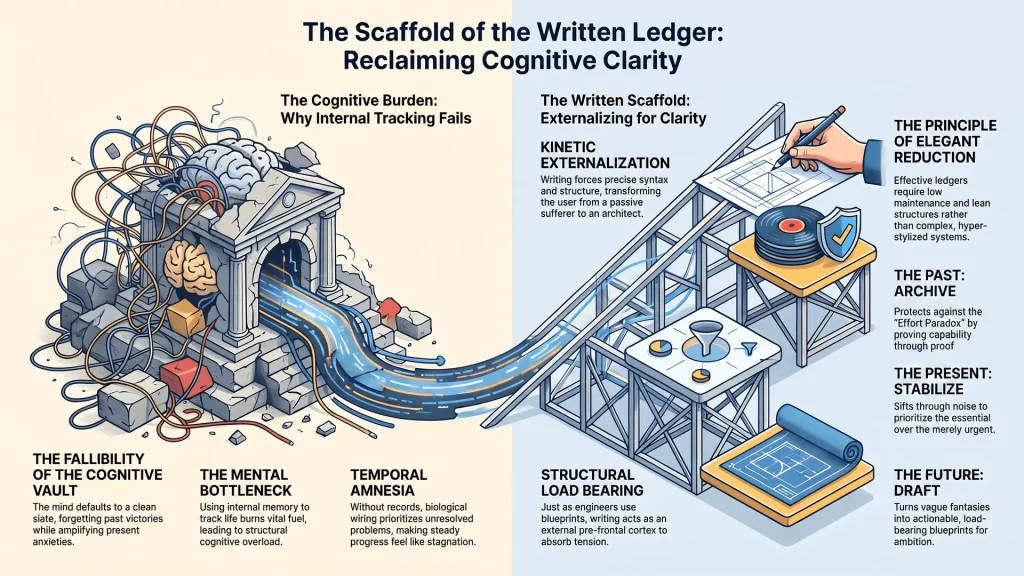
The Fallibility of the Cognitive Vault
We often overestimate our ability to retain the context of our achievements. We assume that because an event felt significant when it occurred, its impact will remain vividly etched in our consciousness indefinitely. Unfortunately, the reality of our modern, high-velocity existence makes this highly unlikely. The sheer volume of incoming stimuli—emails, notifications, urgent demands, and trivial distractions—acts as an abrasive current that rapidly wears away the memory of our quiet progress, often leaving us (as you often discover at the end of an exhausting, unrecorded month) wondering where our time actually went.
The mind, when exhausted or stressed, naturally prioritises threats and unresolved problems over completed tasks—highlighting what is broken while ignoring what is functioning.
When we rely solely on our internal memory to track our trajectory, we fall victim to a form of temporal amnesia. The mind, when exhausted or stressed, naturally prioritises threats and unresolved problems over completed tasks. It highlights (and even amplifies) what is broken while ignoring what is functioning. This cognitive bias means that without an objective, external record, your perception of your life will almost always skew toward stagnation. You will feel as though you are standing still even when you are making steady, incremental progress (and it absolutely does!). The written ledger is the only tool that can break this optical illusion, providing a cold, hard anchor of facts that our subjective anxieties cannot easily sweep aside.
Underneath this cognitive amnesia lies an ancient evolutionary mechanism designed for survival rather than satisfaction. Your brain’s default operating system is biologically engineered to scan for immediate danger, meaning that an unrecorded task or a looming uncertainty will always hijack your attention far faster than a completed project. When you fail to write down your victories, you are essentially leaving your self-worth at the mercy of this hyper-vigilant neural wiring, meaning that a single unanswered correspondence can easily overshadow a massive, thousand-word milestone (an optical illusion I routinely battle) unless you physically write the achievement down to anchor your focus. By establishing a written ledger, you override this primal survival mechanism, replacing survival-driven anxiety with an objective record of your ongoing evolution.
The Kinetic Act of Externalisation
The simple, unvarnished act of writing things down is often dismissed as a mundane organisational chore, something to be outsourced to automated digital planners or superficial life-management applications. Yet, I am increasingly convinced that the physical or digital translation of thought into text is one of the most powerful kinetic interventions at our disposal. When we write, we are not merely recording data; we are performing an act of externalisation. We are taking the chaotic, nebulous, and often contradictory thoughts swirling within our minds and forcing them into a concrete, structured, and manageable form.
By externalising our mind, we create a necessary psychological distance between ourselves and our thoughts, transforming us from passive sufferers of our mental noise into active architects of our daily reality.
This kinetic act forces a level of clarity that silent contemplation can never achieve. To write a sentence, you must select specific words, organise your syntax, and commit to a particular meaning. This process strips away the fuzzy, non-committal boundaries of abstract thought. It forces you to define your goals, your obstacles, and your achievements with complete precision. There is, undeniably, a profound difference between vaguely feeling like you had a productive day and actually seeing five specific, completed tasks written down in black and white. By externalising our mind, we create a necessary psychological distance between ourselves and our thoughts (while reclaiming control of our focus), transforming us from passive sufferers of our mental noise into active architects of our daily reality.
Think of an engineer laying out structural steel beams before a single bolt is turned; they do not simply guess the load capacity of a bridge from a distance. They sketch the coordinates, calculate the tolerances, and physically map the stresses, recognising (a physical practice that instantly reduces cognitive tension) that clarity is a matter of dynamic structural alignment. The act of writing serves as your external pre-frontal cortex—a physical extension of your cognitive capacity that absorbs the ambient tension of your open loops. When you commit your thoughts and actions to paper, you are no longer trying to hold the building together with raw, exhausting willpower; instead, you are letting the written scaffold bear the structural load for you.
The Three-Dimensional Instrument Panel
Without a written ledger, we are essentially navigating a vast and unpredictable ocean without a map or a captain’s log, relying entirely on raw, exhausting willpower to remember our coordinates. A structured log provides an objective, unvarnished picture of our reality across three distinct temporal planes, functioning as a three-dimensional instrument panel for our existence. It strips away the emotional confusion of your daily grind and replaces it with calibrated, reference-grade metrics that you can read at a single glance.
- The Past: It archives what has actually happened, serving as an undeniable repository of our micro-triumphs that protects us from the deceptive, amnesic pull of The Effort Paradox. It allows us to look back during moments of doubt and find objective proof of our capability.
- The Present: It stabilises what is currently occurring, allowing us to sift through the daily noise and prioritise the essential over the merely urgent. It serves as a visual boundary that prevents our attention from being fractured by competing distractions.
- The Future: It drafts what is to happen, giving shape to our long-term ambitions before they have a chance to degenerate into vague, intimidating fantasies. It turns our aspirations into actionable, load-bearing blueprints.
This systemic organisation ensures that your energy is never wasted on the cognitive overhead of simply trying to remember what you should be doing. In aviation or advanced seafaring, a captain does not look out into a blinding storm and guess their altitude, pitch, or heading; they rely entirely on calibrated dials (an engineering choice that prevents systemic failure in high-stress environments) to guide their decisions. Your life requires the exact same level of diagnostic precision. If you are trying to navigate your professional career and personal well-being by “feel” alone, you will inevitably succumb to spatial disorientation during stressful times.
By organising your daily ledger into these distinct temporal modules, you eliminate the cognitive friction of deciding what to do next. Your energy is no longer drained by the toxic exhaust of decision fatigue; instead, it is directed entirely into kinetic execution. You look at your written dashboard, identify the immediate, high-leverage move, and execute it with complete, undisturbed clarity. This level of order transforms your daily hustle from a series of frantic, uncoordinated scrambles into a highly deliberate, beautifully aligned flow.
The Principle of Elegant Reduction
To implement this scaffold, you do not need to adopt a highly complex, hyper-stylised journal system that feels like a second job (which usually falls by the wayside after a fortnight of performative enthusiasm). We do not need colourful templates, intricate tracking metrics, or rigid, multi-layered planning philosophies (and your mileage may vary, of course). The goal is always elegant reduction. The most effective ledger is the one that demands the least amount of maintenance while providing the highest level of clarity.
The goal is always elegant reduction; the most effective ledger is the one that demands the least amount of maintenance while providing the highest level of clarity.
What is required is not aesthetic perfection, but the grit to show up daily and record the raw metrics of your life with engineering precision. Whether you choose a simple physical notebook or a streamlined digital document, the structure must remain lean. Dedicate a few quiet minutes each morning (the earlier, the better) to mapping your core objectives, and a few minutes each evening (before the day’s details fade) to documenting your micro-achievements and calibration adjustments. By committing your thoughts, actions, and milestones to paper, you move beyond the chaotic, reactive scrambles of modern life. You begin to construct an enduring internal skeleton that keeps you upright, balanced, and perfectly aligned, ensuring that every load-bearing step you take is documented, honoured, and built upon.
Ultimately, the ledger is not about restricting your freedom or binding you to a rigid set of rules; rather, it is about giving your mind the licence to create without the constant, draining background noise of administrative anxiety. By transferring the heavy, structural load of tracking and remembering to an external scaffold, you liberate your creative energy for the task immediately in front of you. As a matter of fact, it’s an immensely rewarding relief I have experienced directly during intense creative blocks when the simple act of offloading my mental logs instantly restored my focus and clarity. There is a profound, quiet power (you will feel it, trust me) in knowing that your trajectory is being objectively recorded. When you no longer have to guess where you stand or worry about what might slip through the cracks, you can engage with your work with absolute presence, secure in the knowledge that your efforts are securely anchored and your direction is fully resolved.