
How frequently (and easily, I might add) do we brush off our marginal gains simply because they fail to make a dramatic splash on our daily landscape? I was reflecting recently on our collective tendency to ignore the minor gears turning within our lives while obsessing over whether the entire machinery has reached its final destination. In my last entry, in which I dissected the frustrating machinery of The Effort Paradox, I touched on the hollow, late-evening stillness that occurs when immense energy is decoupled from a guiding skeleton. But once you decide to step off that frantic, circular treadmill, a new, equally insidious psychological hurdle often presents itself: the outright refusal to honour the quiet progress you are actually making. This is not a mere lapse in observation; it is a structural blind spot that threatens to derail our efforts before they can take root. You might find yourself standing in the quiet wreckage of a collapsed schedule, staring blankly at a wall, wondering why your massive output has left you feeling entirely hollow.
When you cease the frantic, performance-based sprinting of modern busyness, your brain naturally experiences a form of cognitive withdrawal. You are suddenly forced to confront the quiet, unvarnished spaces of your day, where the absence of loud, visible milestones feels less like peace and more like terrifying regression. It is a peculiar sort of limbo—a transitional phase (often the most challenging period of any internal restructuring) in which you must learn to stand still without falling apart. If you do not actively train your perspective to find value in this stillness, you will inevitably succumb to the temptation of restarting the chaotic, empty cycle of busywork simply to quiet your existential unease. You must understand that the cessation of frantic movement is not stagnation; rather, it is the absolute prerequisite for building a life of sustainable, quiet progress.
The Tyranny of the Monumental
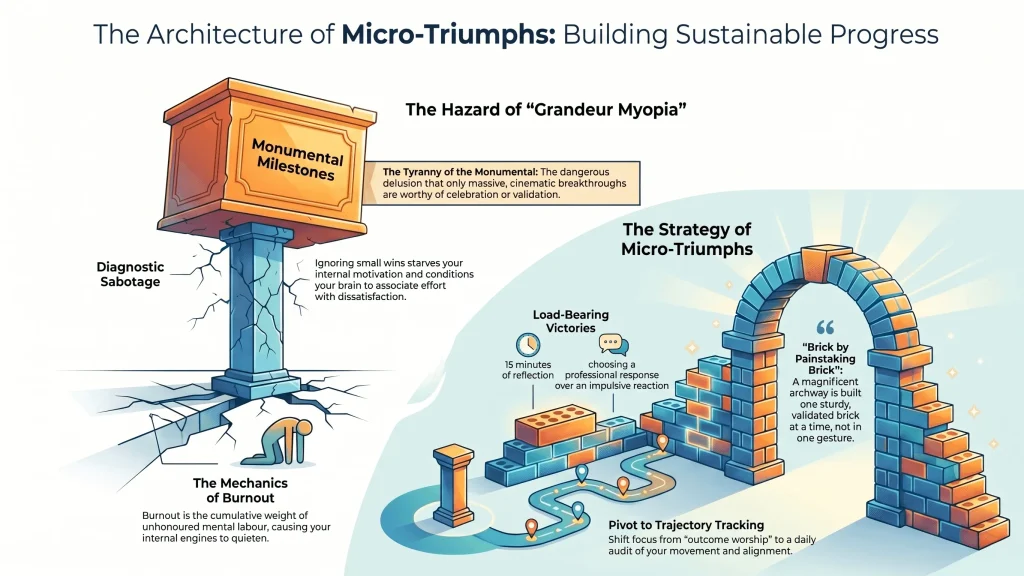
We seem to suffer from a peculiar sort of grandeur myopia; an occupational hazard of our hyper-accelerated culture, where only monumental summits are deemed worthy of celebration. If we do not secure the massive promotion, draft an entire book chapter in a single sitting, or completely revolutionise our lifestyle overnight, we write the day off as an inconsequential wash. I must admit (and I make no excuses for it): I have fallen into this trap myself more times than I care to count, looking past a perfectly executed sequence of daily tasks to lament some vague, unreached horizon. We wait for a cinematic breakthrough, assuming that progress must be loud and highly visible to be valid. You end up constantly scanning the distance for some legendary landmark while completely ignoring the path beneath your feet.
Sustainable change is almost entirely quiet. It is forged in the mundane, unglamorous choices made far from the spotlight.
This obsession with monumental milestones is a dangerous delusion. It forces us to live in a perpetual state of future-deficit, where our present efforts are constantly weighed against an idealised, distant destination and found wanting. By demanding that every step be a giant leap, we turn the pursuit of a balanced life into an exhausting, high-stakes gamble. The reality, of course, is that sustainable change is almost entirely quiet. It is forged in the mundane, unglamorous choices made far from the spotlight. When we anchor our sense of achievement solely to the grand finale, we completely miss the subtle, architectural shifts that make that finale possible in the first place. Think of a long-distance runner who focuses so intensely on the imaginary finish line that they trip over the very real, immediate stones in their path.
Underneath this obsessive drive lies an evolutionary mechanism that we must learn to dismantle. The human brain naturally craves high-contrast, high-dopamine events, making us highly susceptible to the seductive glare of massive, singular achievements. We are biologically wired to celebrate sudden windfall victories. At the same time, our neural circuitry is practically blind to the low-contrast, day-to-day maintenance of our baseline equilibrium—a cognitive blind spot (a trap I routinely encounter during my own intense writing sessions) that keeps us chasing a magical illusion while ignoring the quiet, structural changes that determine our trajectory.
The Mechanics of Diagnostic Sabotage
This dismissive attitude is not merely a harmless display of high standards; it is, in fact, a structural diagnostic error. When you refuse to acknowledge your micro-triumphs (no matter how laughably insignificant they may appear to an outside observer), you are actively starving your internal motivation of its primary fuel source. Being proud of a minor accomplishment is not an exercise in soft, unearned self-indulgence. On the contrary, it is a vital act of calibration. It is the objective recognition that your internal systems are, indeed, functioning. When you overlook these small wins, you fail to register that your internal machinery has successfully completed a load-bearing transaction, leaving your mental blueprint utterly decoupled from your physical reality.
To ignore the micro-triumph is to tell your internal machinery that its work does not matter, which inevitably leads to the quiet shutdown of your drive.
Consider the feedback loop of human behaviour. When we execute an action that aligns with our deeper values, our mind requires a small, positive reinforcement to solidify that neural pathway. If we respond to a constructive choice with apathy or, worse, with frustration that we haven’t done more, we fundamentally engage in a form of cognitive sabotage. We train our brains to associate effort with dissatisfaction, initiating a destructive feedback loop (a friction point I have repeatedly observed in my own creative work) that quietly erodes our capacity to self-start. To ignore the micro-triumph is to tell your internal machinery that its work does not matter, which inevitably leads to the quiet shutdown of your drive.
The long-term cost of this ongoing diagnostic sabotage is a slow, creeping state of chronic internal friction that quietly degrades your creative and psychological stamina. Every attempt to initiate a task begins to feel like wading through deep, freezing water because your mind has been conditioned to expect nothing but cold indifference at the end of the line. This is the precise mechanical root of burnout—it is rarely a sudden failure of capacity, but rather the cumulative weight of unhonoured mental labour, much like a construction team (unacknowledged and somewhat abandoned by their own chief architect) whose morale slowly decays until the crew simply stops caring, the engines quieten, and the entire internal project grinds to a devastating, silent halt (unfortunately, it frequently does).
Anatomy of a Micro-Triumph
To prevent this systemic decay, we must learn to identify what actually constitutes a micro-triumph in the context of a standard, albeit chaotic day. If you managed to sit still for fifteen minutes of focused reflection, or if you successfully turned away from the seductive pull of a digital distraction to write a single, coherent paragraph, you have, technically, executed a micro-triumph. If you paused before responding to an irritating email, choosing a measured, professional distance over an impulsive, heated reaction, that too constitutes a micro-triumph. These are the moments when you draw a line in the sand against the noise of the world, reclaiming your focus and asserting control over your immediate domain—a massive structural win!
These are not trivial, basic tasks; they are active, load-bearing victories over our worst cognitive tendencies. They represent moments where you successfully chose discipline over laziness, simplicity over complexity, and presence over distraction. To gloss over these moments because they lack cinematic scale is to undermine the very foundation of your growth. We must realise that a micro-triumph is not defined by its external volume, but by its internal resistance. The smaller the victory appears to the outside world, the more intimate and significant its impact often is on our psychological architecture. Think of it as a subtle calibration of your compass—a single, one-degree shift that seems utterly invisible in the short run but completely alters your destination over a thousand miles.
For example, let us look at this through a more tactile, structural lens—the intricate joinery of masterfully crafted timber furniture. To the untrained, casual observer, the strength and beauty of a heavy oak table seem to reside entirely in its broad, polished top or its massive, carved legs. However, any skilled craftsman knows that the table’s true structural integrity depends on the invisible wood dowels and hidden mortise-and-tenon joints holding the pieces together—a quiet, hidden architecture (where the most critical load-bearing joints are always buried deep within the core) that guarantees stability without demanding attention. Your daily life fundamentally operates under the same structural law. These quiet, unrecorded micro-triumphs are the invisible dowels of your sanity; without them, the entire framework of your discipline will shear and collapse under the very first wave of external stress.
The Architecture of the Daily Audit
So, moving forward, the primary measure we must adopt is a deliberate pivot from outcome worship to trajectory tracking. This requires us to actively shore up our internal filters and carve out a small, quiet space at the end of each day to validate our movement. We must train ourselves to look at our actions not through the binary lens of “perfection or failure,” but as a series of continuous, load-bearing steps. This daily audit should be objective, logical, and entirely free from the dramatic swings of emotional criticism. You are not putting yourself on trial; you are simply checking the alignment of your building blocks to ensure your psychological foundation remains level.
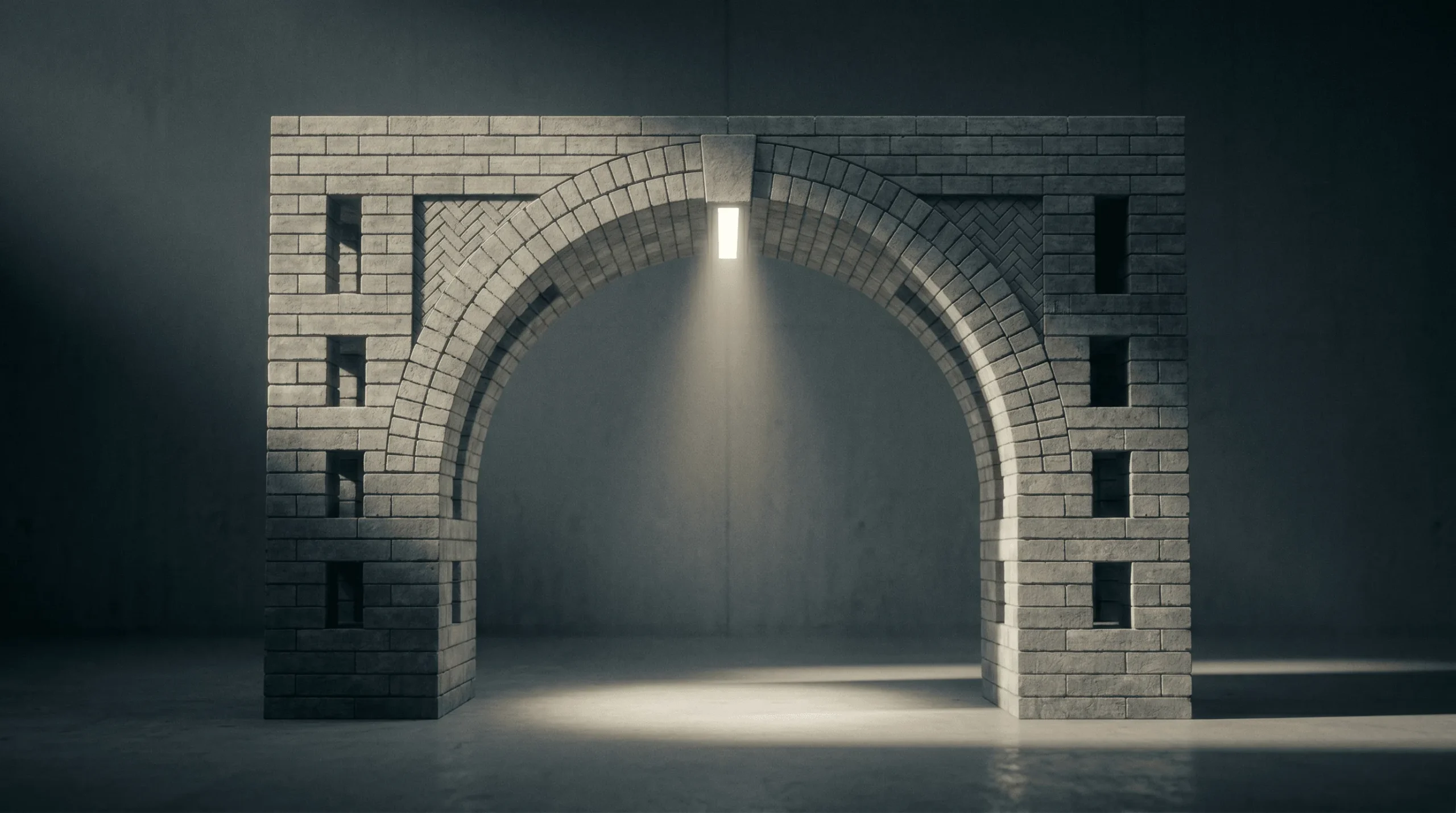
A magnificent archway is never built in a single, sweeping gesture; it is assembled brick by painstaking brick, and each one must be deemed sturdy enough to bear the weight of what is to come.
By celebrating the minor victories, we stabilise our psychological baseline, ensuring we have the stamina to handle the larger, more turbulent shifts in life. We are essentially building a lattice of positive reinforcement that holds our focus steady even when external circumstances remain in flux. After all, a magnificent archway is never built in a single, sweeping gesture; it is assembled brick by painstaking brick, and each one must be deemed sturdy enough to bear the weight of what is to come. If you can learn to trust the integrity of a single brick, the eventual stability of the entire structure becomes inevitable. This systematic practice protects you from the dangerous highs and lows of performative motivation, replacing erratic bursts of inspiration with a steady, quiet momentum.
When you commit to this daily architectural calibration, you finally step out of the shadows of expectation and begin to inhabit a structure of your own deliberate design. You are no longer waiting for some grand, external authority to hand you a badge of validation, nor are you letting your sense of worth be held hostage by the erratic winds of daily circumstance. As a matter of fact, even in my own journey toward completing any project, I have had to remind myself of this exact rule almost daily to keep my focus aligned. By tracking your trajectory with cold, unvarnished precision, you gain the quiet confidence that comes from knowing your movement is real. You can go to sleep tonight with the absolute certainty that you have laid down yet another sturdy brick, and that—above all else—is how a masterpiece is built!