
I have often observed that the modern psyche possesses an almost pathological attachment to the concept of speed. We have, quite collectively, reached a consensus that a packed calendar is synonymous with a productive life, yet I find myself increasingly unconvinced by this frantic display of kinetic energy. In my own reflections (a process that requires a degree of stillness many find uncomfortable), I have begun to identify what I call the Velocity Illusion—the seductive, yet ultimately hollow, belief that the sheer rate of our movement is a reliable indicator of the distance we have covered.
The Cult of Constant Motion
We live in an era that worships the “hustle,” where being “busy” is not merely a state of being, but a badge of honour (one that we wear with a mixture of pride and performative exhaustion). This societal pressure creates a profound distortion in our perception of success. We measure our worth by the number of emails sent, the meetings attended, and the sheer volume of tasks checked off a list, regardless of whether those tasks actually contribute to our long-term objectives.
This environment fosters a desperate need to be seen as “active.” To stop, even for a moment of recalibration, feels like an admission of defeat or a lapse in discipline. However, I suspect that this constant motion is often a defence mechanism—a way to outrun the uncomfortable silence that accompanies deep thought. We keep moving because the alternative requires us to confront the possibility that we might be travelling in the wrong direction entirely.
“The frantic need to be perceived as active overrides the necessity of being effective, leading us into a cycle of kinetic anxiety where exhaustion is mistaken for achievement.”
The Anatomy of Kinetic Anxiety
This state of being, which I have termed kinetic anxiety, is movement in its rawest, most unrefined form. It is the intellectual equivalent of running on a treadmill while expecting to reach a new destination; the heart rate is high, the sweat is real, and the exhaustion is undeniable, but the scenery remains stubbornly fixed. To the observer, and often to ourselves, we look busy. We look as though we are gaining ground. However, without the structural integrity of a clear objective, we are merely oscillating in place.
Kinetic anxiety saps our cognitive reserves, leaving us too tired to engage in the very “Lattice” work that would provide us with true direction. We become reactive rather than proactive, responding to the loudest demands rather than the most significant ones. It is a subtle form of self-sabotage that I have seen derail even the most disciplined individuals. They confuse the noise of the engine for the progress of the journey, unaware that they are burning fuel without engaging the gears.
Mass, Velocity, and the Weight of Intentionality
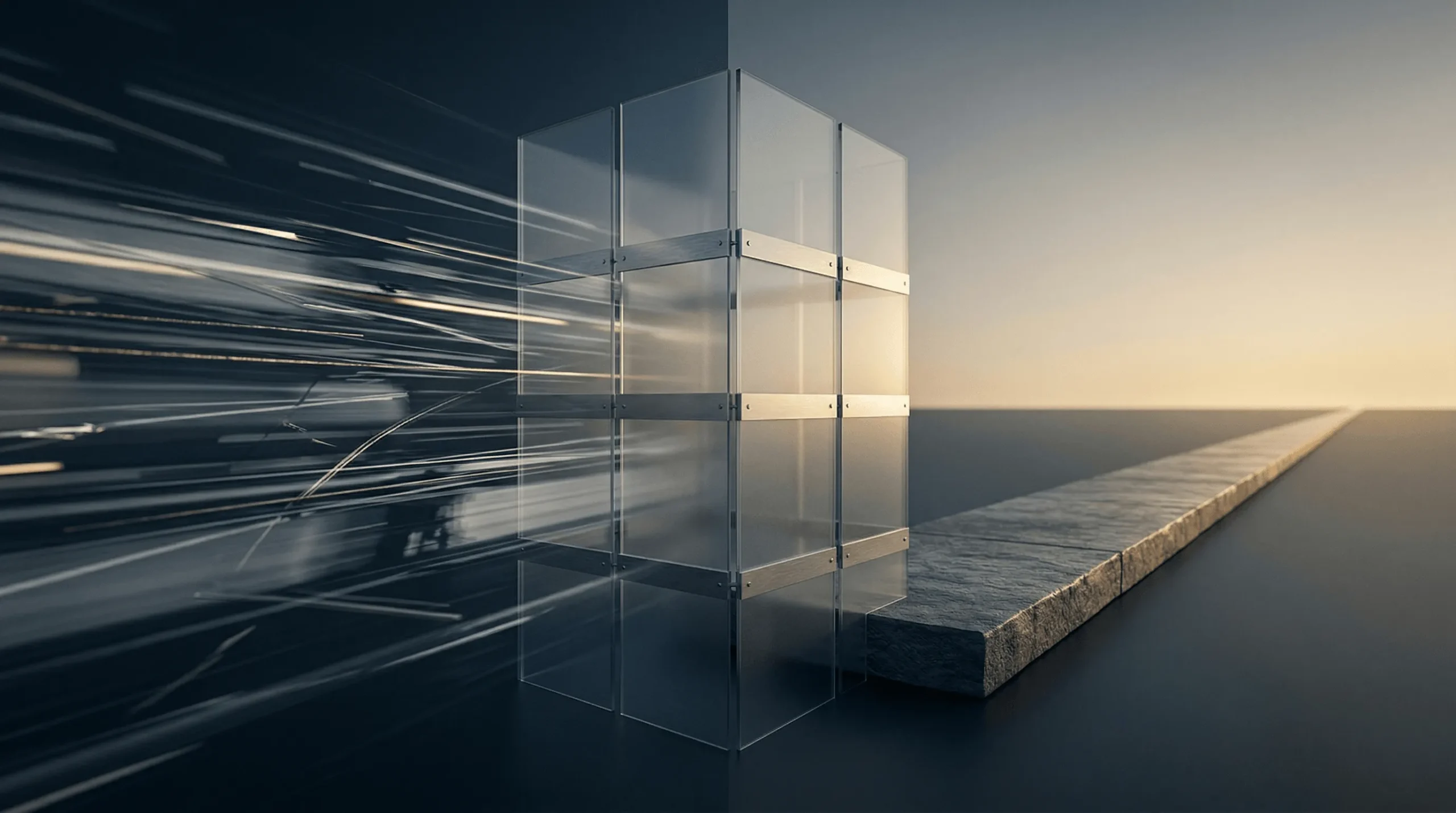
True progress, by contrast, requires momentum. If we look at this through the lens of physics (a discipline that offers remarkable clarity for personal growth), momentum is the product of mass and velocity. In the context of a balanced life, this “mass” is our intentionality. It is the weight of our values, the depth of our research, and the clarity of our purpose. Velocity without mass is just a flicker of movement—a leaf caught in a gust of wind—whereas momentum is a tidal wave.
“Momentum is movement with weight, purpose, and direction; it is the realisation that a single, heavy blow is worth more than a thousand glancing strikes.”
When I speak of momentum, I am referring to those deliberate actions that actually move the needle (a realisation that often arrives only after we have sifted through the noise of superfluous tasks). Momentum does not always feel fast. In fact, it often feels slower and more methodical than the frantic buzz of the Velocity Illusion, precisely because it requires the courage to say no to the “fast” things that lead nowhere. It involves a “thick” type of effort—one that is rooted in a deep understanding of the architecture of our goals.
The Seduction of the Surface
The danger of the illusion lies in its ability to mask stagnation. When we are moving quickly, the wind in our faces provides a sensory distraction that prevents us from noticing we are travelling in circles. We use busyness as a shield against the deeper, more demanding questions of our existence. If we are always “keeping up with” the next demand, we never have to confront the reality of our lack of direction.
This surface-level engagement is comfortable because it avoids the friction of true growth. Moving fast on a paved road is easy; clearing a new path through a forest is slow, arduous, and requires constant recalibration. Many choose the former because it provides the immediate dopamine hit of “completion,” even if the destination is irrelevant. We must learn to distrust the ease of high-velocity activity and instead look for the resistance that signifies true advancement.
Constructing the Intellectual Lattice
To break away from this illusion, we must develop a “Lattice” for our activities—a mental framework that filters out the high-velocity distractions and prioritises the low-frequency, high-impact moves. This requires us to embrace a certain level of stillness, even when the world around us is screaming for more speed. I am convinced that the most profound breakthroughs do not happen during the sprint; they happen when we have the presence of mind to stop, look at the map, and ensure that our velocity is actually serving our destination.
Building this lattice involves an audit of our “kinetic output.” We must ask ourselves: if I stopped moving today, what would remain? If the answer is “very little,” then we have been victims of the Velocity Illusion. By introducing intentional “friction” into our decision-making process—forcing ourselves to justify the speed of our actions—we can begin to shift from movement to momentum. After all, there is very little point in being the fastest person on a road that leads to a dead end.